Article
Jerry Goldsmith and the Broken Ear of Planet of the Apes
An anthropological reading of Jerry Goldsmith's score for Planet of the Apes, an impure, modern and displaced music for a civilization after man.

There are films that reveal all their secrets through a single image, and among them Planet of the Apes (Franklin J. Schaffner, 1968) does so masterfully. The revelation of the Statue of Liberty half-buried on a beach makes George Taylor, played by Charlton Heston, and with him all of us, understand with blunt and inescapable force that the strange planet on which he had landed was Earth, that humanity had turned its progress into ruin and that the future was an archaeology of our arrogance.
Yet that revelation begins long before we arrive at that doomed beach, because throughout the film the music composed by Jerry Goldsmith, one of the most uncomfortable scores produced by Hollywood in the late sixties, is already anticipating such an ominous outcome.
From Space Epic to Inverted Planet
Until Planet of the Apes, adventure-oriented science fiction had often relied on traditionally heroic scores, in which music treated space as an extension of the epic journey, with broad orchestra, brass, recognizable themes and a sense of conquest, as happened in Destination Moon (Irving Pichel, 1950), When Worlds Collide (Rudolph Maté, 1951) or The War of the Worlds (Byron Haskin, 1953), all with music by Leith Stevens. This model inherited much from war cinema, the western and colonial adventure, to the point that the rocket became a kind of modern caravel, prepared for a great, dangerous and noble human enterprise, while the cosmos still sounded like a frontier to be conquered. Even in sixties television, the theme for Star Trek (1966), composed by Alexander Courage, sustained that expansive confidence through a luminous, martial fanfare.
Alongside that heroic model there was another sonic tradition, less epic in breath and darker in atmosphere, in which space took on the character of technological mystery, nuclear threat and Cold War uncertainty. It can be traced in It Came from Outer Space (Jack Arnold, 1953) and This Island Earth (Joseph M. Newman, 1955), both associated with Universal’s music team, with Herman Stein, Irving Gertz and Henry Mancini among its main composers, where the cosmos appears as an unstable contact zone between science and paranoia.
The Day the Earth Stood Still (Robert Wise, 1951), with music by Bernard Herrmann, opened that path in exemplary fashion through the use of theremins, organ, brass, percussion and electric timbres, building a score that was highly advanced for its time, in which the extraterrestrial sounded disturbing and solemn at once.
In that same search for new sounds for space, Forbidden Planet (Fred M. Wilcox, 1956), with electronic music by Louis and Bebe Barron, pushed the rupture much further by replacing orchestral Hollywood with circuits, hums, glissandi, pulses and abstract textures. More than a traditional score, it proposed an electronic soundscape, and its importance lies in having formulated earlier than almost anyone else the decisive idea for modern science fiction that space had to sound like unknown matter.
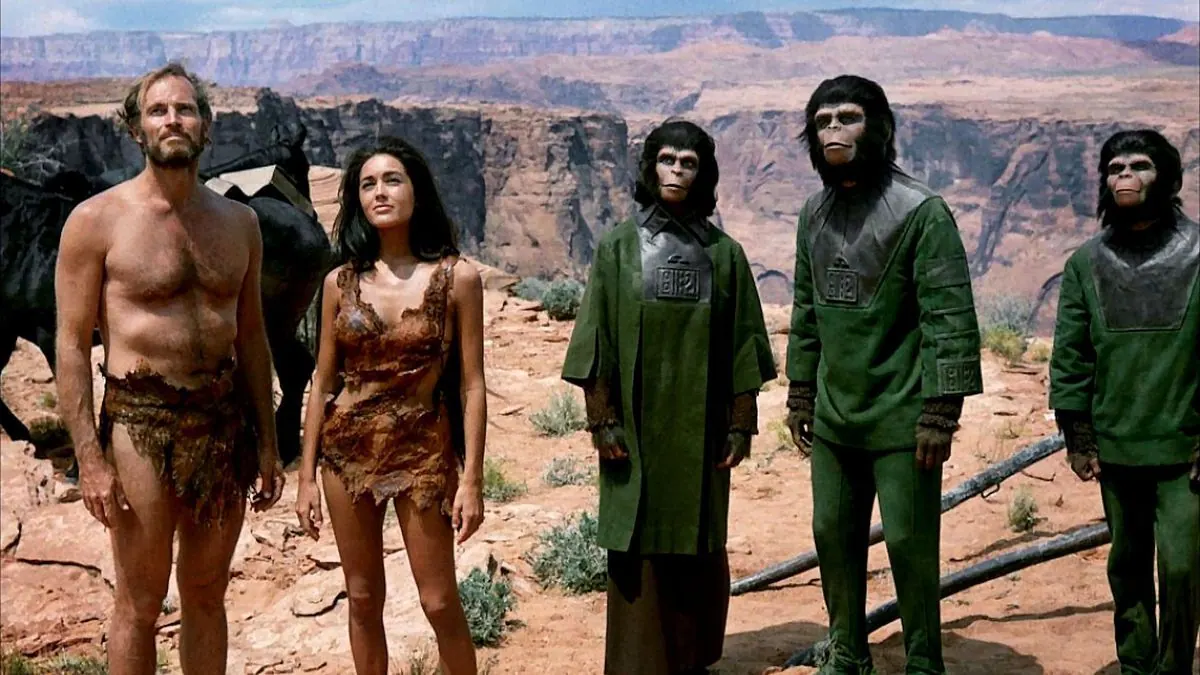
Planet of the Apes begins from another kind of strangeness. Schaffner imagines a future Earth in which human categories have been inverted. Goldsmith’s response therefore had to be different. In contrast to the Barrons’ electronic landscape, his score turns the ear toward the anthropological, which is after all Cinetropo’s natural territory, and makes us hear, almost against our will, the absolute discomfort of a degraded humanity.
After this lineage of space musics, the great break of 1968 was double. 2001: A Space Odyssey, after Kubrick discarded Alex North’s original score, used pre-existing music by Strauss, Ligeti and Khachaturian to turn space into a metaphysical experience. Planet of the Apes, by contrast, turned to Goldsmith to transform science fiction into a crisis of human centrality, consistent with a film that, beneath its appearance as futuristic adventure, responded to an American society fractured by Vietnam, racial conflict, political assassinations, youth protest and distrust toward its own myths of progress (Oteiza Lacalle, 2025, pp. 204-207). Kubrick looked to the cosmos and found the sublime. Schaffner and Goldsmith looked to the future and found an autopsy of civilization.
Musical Modernity as Archaeology of Ruin
That difference is perceived from the opening minutes. As Jon Fitzgerald and Philip Hayward point out, before the viewer has seen a single image of the planet of the apes, Goldsmith has already destabilized listening through an atonal, percussive and thematically dense overture, leading the ear from music that still preserves some point of support toward an unstable and threatening mode of listening. That logic is confirmed in the forced landing of the spacecraft, when the environmental roar of the descent is transformed without a perceptible cut into dissonant orchestral writing made of metallic blows, rhythmic accents, rapid wind passages, multiple percussion and brass clusters. From that moment on, the music seems to spring from the planet itself. Extended silences then empty the landscape of all human familiarity, and the march through the desert accumulates echoing sounds, low piano tones, irregular percussion, scrapings, semitone clashes and primitive horns, materials that culminate in the hunt sequence, dominated by the ram’s horn, the rising perfect fifth, superimposed ostinatos, displaced accents and parallel dissonant chords (Fitzgerald and Hayward, 2013, pp. 34-36).
The instrumental choice reinforces that reading. Goldsmith avoids constructing estrangement through futuristic electronics, as Louis and Bebe Barron had done in Forbidden Planet, and instead uses acoustic instruments pushed into a zone of friction: dry percussion, archaic horns, aggressive brass, piano treated almost as raw matter, woodwinds in uncomfortable registers and dissonant orchestral textures. The choice is crucial because Schaffner’s planet is articulated as a regressive, hierarchical, ritualized and recognizably terrestrial society. The music had to sound strange, though not completely alien. It had to retain something human so that the inversion would be more uncomfortable.
That strategy does not arise in a vacuum. In an interview published in the special Cinefantastique issue devoted to Planet of the Apes, Goldsmith cited Stravinsky, Bartók, Berg and Schoenberg as influences for this score, composers who had put inherited musical conventions into crisis through dissonance, rhythmic primitivism, folkloric research, atonality and the emancipation of dissonance (“Jerry Goldsmith: Composer Apes 1 and 3”, 1972, p. 37). Goldsmith draws on European musical modernity to imagine a planet where terrestrial convention has been defeated. From Stravinsky he seems to take ritual energy, superimposed ostinatos and the rhythmic violence associated with The Rite of Spring. From Bartók, modal harshness, dry percussion and a sense of reinvented archaism. From Schoenberg and Berg, the rupture of the tonal center and the freedom of dissonance. The result is a score that turns procedures of the musical avant-garde into signs of an inverted civilization, dominated by hunting, law, religion and hierarchy.
Sonic Matter Out of Place
Mary Douglas’s reading is especially useful here because it shifts the problem from aesthetics to cultural order. In Purity and Danger, Douglas begins from a fundamental thesis for symbolic anthropology. Societies organize the world through classifications. They separate the human from the animal, the clean from the contaminated, the civilized from the savage, the proper from the foreign, the permitted from the forbidden. These divisions order reality, make it habitable and allow a culture to recognize itself as a coherent system (Douglas, 1973, pp. 54-61). That is why Douglas warns, already in the opening note of her book, that no symbol of contamination can be understood in isolation, because it only acquires meaning within the total structure of classifications of a culture (Douglas, 1973, pp. 9-19).
From there one understands her celebrated definition of dirt as matter out of place. Douglas presents it as an altered relation to order. Something becomes dirty when it appears where a culture does not expect to find it, when it crosses a boundary and disturbs a classification. Soil in the garden belongs to the order of things. The same soil on a table becomes dirt. The problem lies in displacement. Douglas affirms that where there is dirt there is system, because dirt is the by-product of a prior ordering of matter. Matter can only be out of place when there is a prior idea of place, boundary and order.
This principle illuminates the music of Planet of the Apes. Goldsmith works with recognizable instruments from the Western musical world, piano, brass, woodwinds, percussion, horns and strings, but displaces them from their usual functions. The piano abandons its harmonic or melodic role and becomes struck matter. The brass loses its heroic grandeur and acquires an aggressive authority. Percussion abandons the regularity of the march and approaches a fragmentary violence. The horns evoke the hunting call rather than epic nobility. The orchestra, symbolic center of classical Hollywood, appears contaminated by roars, scrapings, silences and archaic gestures. Everything still belongs to the world of Western music. Everything seems, at the same time, displaced from its site.
Douglas’s second decisive idea is anomaly: that which does not fit within a system of classification and, precisely for that reason, forces a revision of the order that had seemed natural. In Planet of the Apes, that anomaly affects the whole represented world. Humans preserve their form, though they have lost language, culture and symbolic authority. Apes, by contrast, occupy the place of law, religion, science and hierarchy. The film is thus organized as a classificatory inversion, where the animal occupies the place of culture and the human is displaced toward silence, prey and available body.
Goldsmith translates that anomaly into the sonic plane through music that also refuses stable classification. The viewer does not know whether they are hearing music, noise, landscape, threat, ritual, animality or technology. The ear attempts to order the experience, while the score continually withdraws its supports. In this way, the symbolic contamination that runs through the film also affects listening. Human and animal, civilization and barbarism, progress and ruin, rite and violence, science and dogma, future and past no longer remain in separate compartments. Each timbre seems to have crossed a boundary. Each musical gesture retains something familiar and, at the same time, appears deformed by an order that no longer belongs to the human being.
For that reason Goldsmith’s score can be understood as impure music for an impure world. Its force proceeds from that sonic matter out of place, from that mixture of human instruments, animal calls, ritual percussion, uninhabited silences and dissonances that prevent the ear from resting in a known hierarchy. The film narrates the fall of man as the center of the world. The music performs that fall first as an experience of listening.
Listening to Man Out of Place
From this perspective, the soundtrack is organized as a perceptual experience. In terms close to Michel Chion, the music modifies the reading of the image and prepares an audiovision in which the planet is already perceived as a broken order. It can also be understood, following Christopher Small, as a practice of listening that places the spectator inside a new, uncomfortable and hierarchically inverted relation. The soundtrack is inhabited. Taylor thus passes through an experience close to liminality, suspended between his former condition as human explorer and his new condition as capturable body, speaking anomaly and threat to the ape order.
The anthropological consequence is decisive. Colonel George Taylor, played by Charlton Heston, has landed in a system that has reorganized the fundamental positions of the human world. The explorer becomes a capturable piece, the speaker a mute body, the rational subject an observed animal. Goldsmith’s music magnifies that degradation before the plot makes it explicit. When Taylor falls to his knees before the Statue of Liberty half-buried on the beach, the image finally orders what the score had already disordered. The music had taught us to hear a world where man was out of place.
References
Chion, Michel. Audio-Vision: Sound on Screen. Columbia University Press, 1994.
Douglas, Mary. Purity and Danger: An Analysis of Concepts of Pollution and Taboo. Routledge, 1966.
Fitzgerald, Jon, and Philip Hayward. “The Sound of an Upside-Down World: Jerry Goldsmith’s Landmark Score for Planet of the Apes (1968).” Music and the Moving Image, vol. 6, no. 2, 2013, pp. 32-43. DOI: 10.5406/musimoviimag.6.2.0032.
Goldsmith, Jerry. Planet of the Apes. Original Motion Picture Soundtrack. 20th Century Fox, 1968.
“Jerry Goldsmith: Composer Apes 1 and 3.” Cinefantastique, vol. 2, no. 2, special Planet of the Apes issue, summer 1972, p. 37.
Oteiza Lacalle, Francisco. El extraterrestre eres tú. Representaciones y significados del extraterrestre en la cinematografía internacional. Editorial Sindéresis, 2025.
Small, Christopher. Musicking. The Meanings of Performing and Listening. Wesleyan University Press, 1998.
Turner, Victor. The Ritual Process: Structure and Anti-Structure. Aldine, 1969.
Readers
Would you like to comment on this essay or suggest a related reading?
Write to us at info@cinetropo.com.