Article
The Sky and the Abyss: John Williams, Jerry Goldsmith, and the Symphonic Battle for the Cosmos
An anthropological reading of science-fiction music: John Williams's mythic symphonism set against Jerry Goldsmith's unsettling, liminal and experimental cosmos.
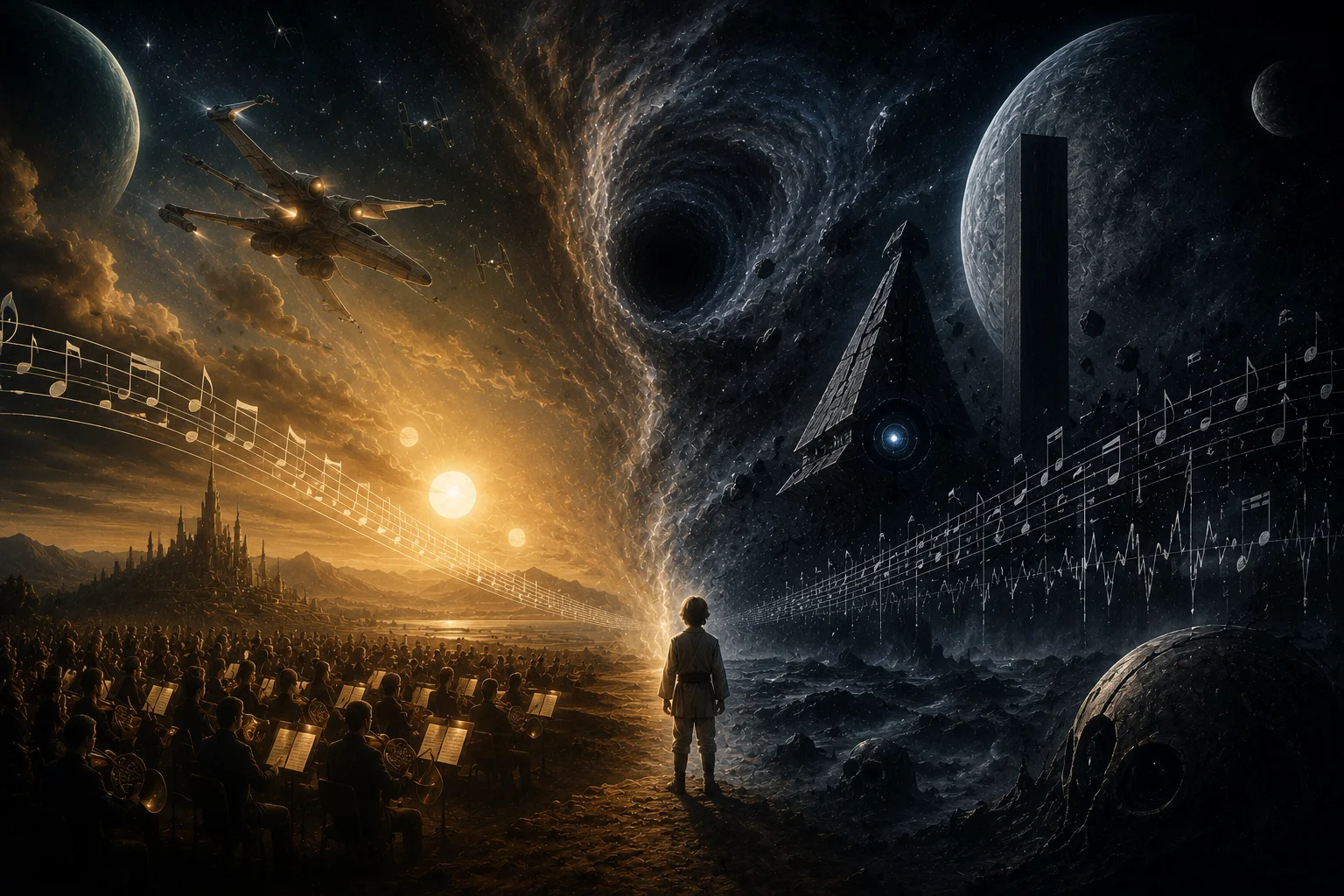
In 1977, Star Wars inaugurated a new era of cinema, populated by androids, laser hums, and starfighters, all of it wrapped in a sweeping symphony orchestra. That musical gesture broke with the tendencies of previous decades on two fronts. First, it recovered for contemporary Hollywood an orchestral breadth that had been displaced by electric guitars, pop compilations, and minimalist scores. Second, it upended the sonic tradition of science fiction, which had frequently relied on strange, futuristic-sounding instruments — the theremin chief among them — electronic composition, atonality, noise, or silence to express the strangeness of the cosmos.
Williams made the future stop sounding technological and start sounding mythical. That opening fanfare announces something more than an advanced universe. Before the adventure even appears, the music summons a world of lineages, destinies, sacrifices, and doom. There lies the central tension that drives his symphonism: the image looks toward the future while the music recovers an ancient grammar of myth and elevation.
The film’s great achievement rests on the rift that opens between the two sonic textures competing for the viewer’s ear. The sound effects are cold and synthetic, accompanying the image in its character as a technological adventure. The symphonic score, by contrast, is charged with a past that the plot itself barely sketches. The leitmotif, inherited from Wagner and rewritten by Williams, shapes Luke Skywalker as a mythic figure, granting him a heroic past and linking him to classical heroes. In that duality lies the film’s true ideological architecture: imperial technology against the genealogy of the classical hero.
Like Theseus, Luke belongs to a lineage he does not yet know, but which the music already anticipates. This musical prefiguring of anagnorisis is already hinted at in the famous Main Title, which proclaims him as the hero of the adventure, and takes on a far more defined genealogical sense in the theme of the Force. Against the affirmative, martial character of the Main Title, the Force theme opens a space of contemplation and transcendence. Its broad, solemn melody, its flexible rhythm, and its upward drive unfold over a harmony that delays resolution, as if Luke’s identity were already announced but could not yet be revealed, while the horns and strings reinforce that impression of an inner calling.
The theme first appears in fragmentary form when Leia entrusts the plans to R2-D2, still tied to a barely formed hope. Later it unfolds in full before Tatooine’s twin suns, in one of the most beautiful scenes in the entire saga. There, the score links Skywalker to a tradition he does not yet know — the Jedi, the absent figure of the father, and an identity the story still keeps hidden.

Before John Williams, much of science-fiction cinema had built its sonic identity around estrangement. The theremin of The Day the Earth Stood Still (1951), the electronic tonalities of Louis and Bebe Barron for Forbidden Planet (1956), and the harsh percussion of Planet of the Apes (1968) placed the future outside ordinary musical experience. In 2001: A Space Odyssey (1968), Kubrick took this rupture down another path. He rejected a conventional original score and combined preexisting classical works with the avant-garde of György Ligeti. Johann Strauss’s waltz turns the movement of the spacecraft into a recognizable dance, while Ligeti’s choral masses and dissonant textures reserve for the monolith a sound that seems to escape all human measure. The music helped build an unknown, emotionally distant space, sharpening the separation between the human and whatever exceeded its categories.
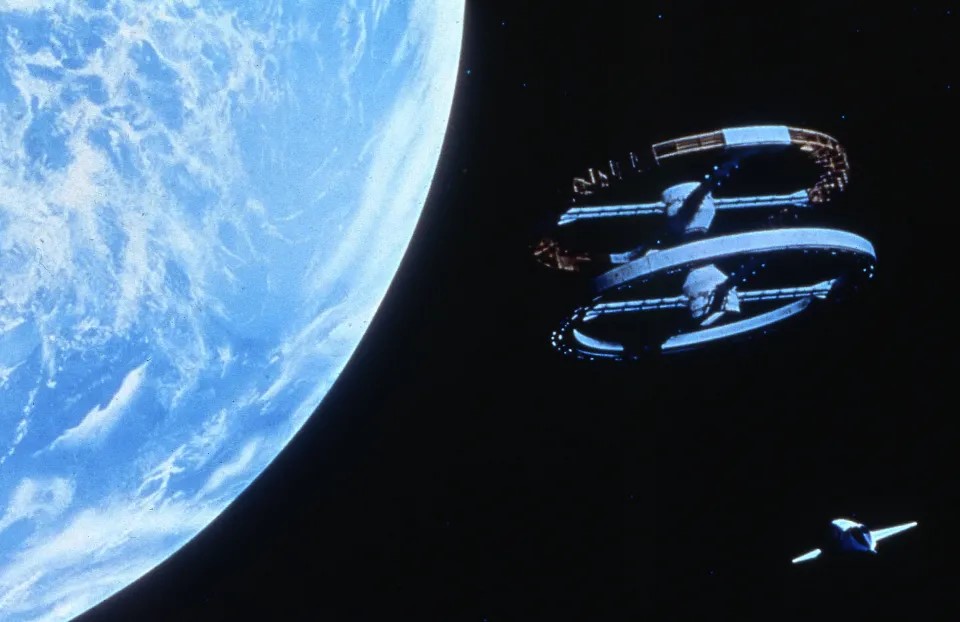
Williams’s return to the grand symphony orchestra was not an inevitable consequence of the genre. His turn consisted in giving the cosmos a recognizable emotional form. The orchestra acts as mediator between the unknown universe and the community of viewers, translating remote planets, alien creatures, and invisible forces into the familiar language of myth, adventure, and Western musical memory. From an anthropological perspective, this procedure can be understood as a ritual domestication of the strange. The rite does not eliminate danger or dissolve otherness, but it organizes the experience and makes it possible to move through it. In Victor Turner’s terms, the space voyage becomes a liminal phase in which ordinary categories are suspended and the viewer enters another world guided by a music that offers continuity and orientation. Williams opens before us the doors of a strange cosmos and, through the orchestra, turns its immensity into an experience we can inhabit.
But let us return to that instantly recognizable opening motif. We can assume those notes function as a ritual call that gathers the room into a shared emotional time, coordinating and preparing the collective for a story. Durkheim described this phenomenon as collective effervescence. In The Elementary Forms of Religious Life (1912), he argued that no society can do without periodically reaffirming its shared sentiments, and that this moral renewal can only be achieved through gatherings and assemblies where individuals, standing closely together, jointly reaffirm their common feelings. The darkened, silent movie theater partially reproduces that structure without needing to turn it into religion. Viewers, strangers to one another until then, are drawn together by a shared affective disposition the instant the brass call sounds.
At that moment, the music functions as an operator of belonging. It needs no narrative explanation to produce its effect, because it acts before the story has fully organized itself. Before a single meaningful image appears, before the viewer even knows what is about to happen, the score has already placed them inside a shared experience. The story, once it arrives, will find an audience already emotionally prepared to receive it.
Christopher Small allows us to complete this reading from another angle. His concept of musicking understands music as an action, a social act that builds community in the very moment it is produced. Applied to cinema, this allows us to think of the theater as a space where the act of listening itself produces social relation. Durkheim lets us understand the theater as an emotional assembly, and Small carries that intuition into the realm of listening, where music acts as a shared social practice.
Once the story is underway, the score also begins to organize the interior of the narrative world. In Star Wars, the leitmotif identifies characters, places, and situations, and projects that function into a moral orientation that organizes the narrative universe before the viewer even perceives the forces that govern it, the bonds that sustain it, and the destiny toward which its characters are heading. In this way, the music transforms the great oppositions of myth into audible memory. If Lévi-Strauss understood myth as a structure organized through relations and opposites, Williams’s score lets us hear those oppositions within the story itself. Empire and Rebellion, Force and domination, lineage and orphanhood, fall and redemption take on, beyond the narrative plane, a recognizable musical form. The immediate precedent lies in Wagner, who turned the leitmotif into a network of dramatic associations, and in Korngold, who carried that logic into Hollywood adventure. Williams inherits both models and adapts them to a mass cinema in which the score guides interpretation, anticipates revelations, and fixes the story’s moral order in memory.
A similar operation appears a year later in Superman (1978), though in a different form. In Superman, Williams’s symphonic writing abandons the passage toward otherness and instead works to legitimize the presence of a superior being within the everyday world. The famous march turns flight into an expression of moral authority. Its upward drive, the clarity of the brass, the steady pulse, and the luminous character of the melody convey strength, elevation, and dominance, while presenting that power as a protective force.
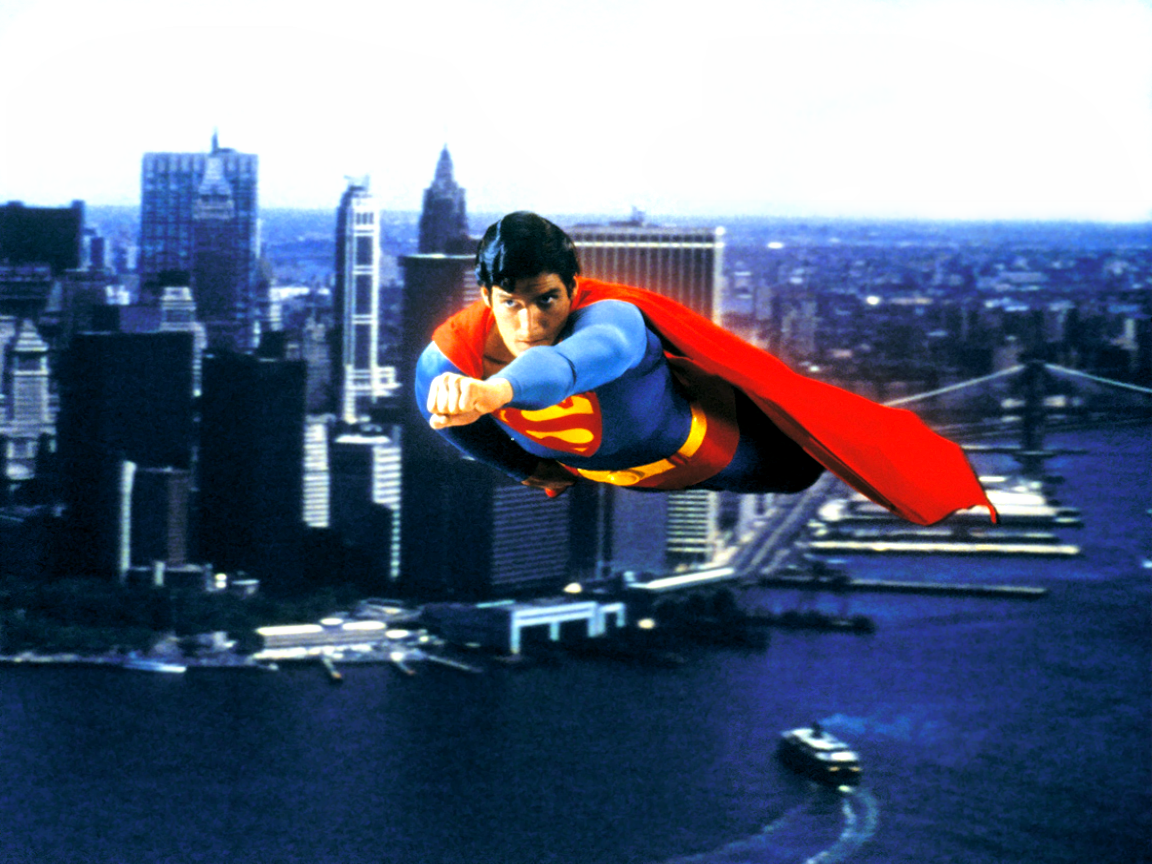
From an anthropological perspective — the terrain on which this analysis is situated — this operation can be read through what Max Weber defined as charismatic authority, a form of legitimacy grounded in exceptional qualities that a community recognizes as worthy of trust and obedience. Applied to the musical effect of the march, that idea helps explain how Williams transforms Superman’s physical superiority into moral authority.
In Close Encounters of the Third Kind (1977), Williams shifts the mythic center of gravity. The musical function moves away from legitimizing the hero and morally ordering the adventure, toward imagining a possible relationship with a radically alien intelligence. The famous five-note sequence condenses that operation. Its simplicity allows the music to function as an elemental language, prior to or parallel with verbal speech. The melodic cell has something of a minimal, almost syllabic phrase, built to be repeated, recognized, and answered. That is why the scene is organized as a call and response, where listening to and returning the motif is enough to establish a bond. Humans and extraterrestrials recognize one another through a shared way of making music, beyond scientific explanation or political translation. The Other then sheds its condition as a hostile presence or distant enigma and becomes an interlocutor.
This logic returns in E.T. the Extra-Terrestrial (1982), though shifted from an encounter between civilizations to an intimate bond between two marginal beings. The Spielberg–Williams alliance uses childhood as a state of openness toward the impossible. Elliott and E.T. occupy a liminal space between the childlike and the adult, between everyday life and the eruption of the extraordinary. The music sustains that in-between zone and prepares the viewer to accept the miracle. In the bicycle-flight scene, the Flying Theme turns the chase into ritual passage. The orchestral writing begins from the urgency of the escape, with fast figurations pushing the action forward, before opening into a long-arched melody, carried by strings, brass, and luminous harmony. The bicycle — that quintessential object of suburban, everyday childhood — takes on new meaning through the music. When they finally take flight, the image continues a transformation the score had already prepared. Spielberg summed it up years later when he said that, without John Williams, the bicycles could never have truly flown.

If Williams was the great restorer of heroic symphonism in mass cinema, Goldsmith was his more restless, experimental reverse. He too recovered the power of the grand orchestra, but subjected it to modern tensions — dissonance, harsh percussion, strange timbres, fragmentary writing, and a far more ambiguous relationship with myth. Where Williams organizes the cosmos as myth, Goldsmith keeps it open as enigma.
To understand precisely what separates them, it helps to bring in the idea of liminality developed by Turner, building on Arnold van Gennep’s earlier scheme, which describes every rite of passage in three phases: separation, margin, and reincorporation. Williams’s music travels through all three. It separates the viewer from the ordinary world, holds them in the margin for as long as the wonder lasts, and finally reincorporates them into a community of mythic meaning, with recognizable lineage, destiny, and belonging. Goldsmith halts the rite at the second phase. His music separates and keeps the viewer suspended in the margin, far from any safe ground. That is why so many of his compositions indefinitely prolong the strangeness that Williams hurries to resolve.
That inversion reaches one of its most radical expressions in Planet of the Apes (1968). Dry percussion, timbral roughness, rhythmic fragmentation, and the use of extended techniques — reversed reeds, col legno bowing, metal clusters — build a world in which human security has vanished before the plot even confirms it. The score accompanies a genuine anthropological humiliation, in the literal sense of the term.
One of his major works, Alien (1979), pushes that extreme displacement even further. Space loses any promise of adventure and appears instead as emptiness, organic threat, and indifference. Goldsmith shapes that hostility through writing that always seems to advance at the edge of form: metallic glissandi, vibrato-less string clusters, breathy winds, isolated percussion strikes, and long silences that leave the viewer without acoustic ground. The orchestra abandons the heroic horizon, fragmenting, contracting, and erupting as though space itself were alive.
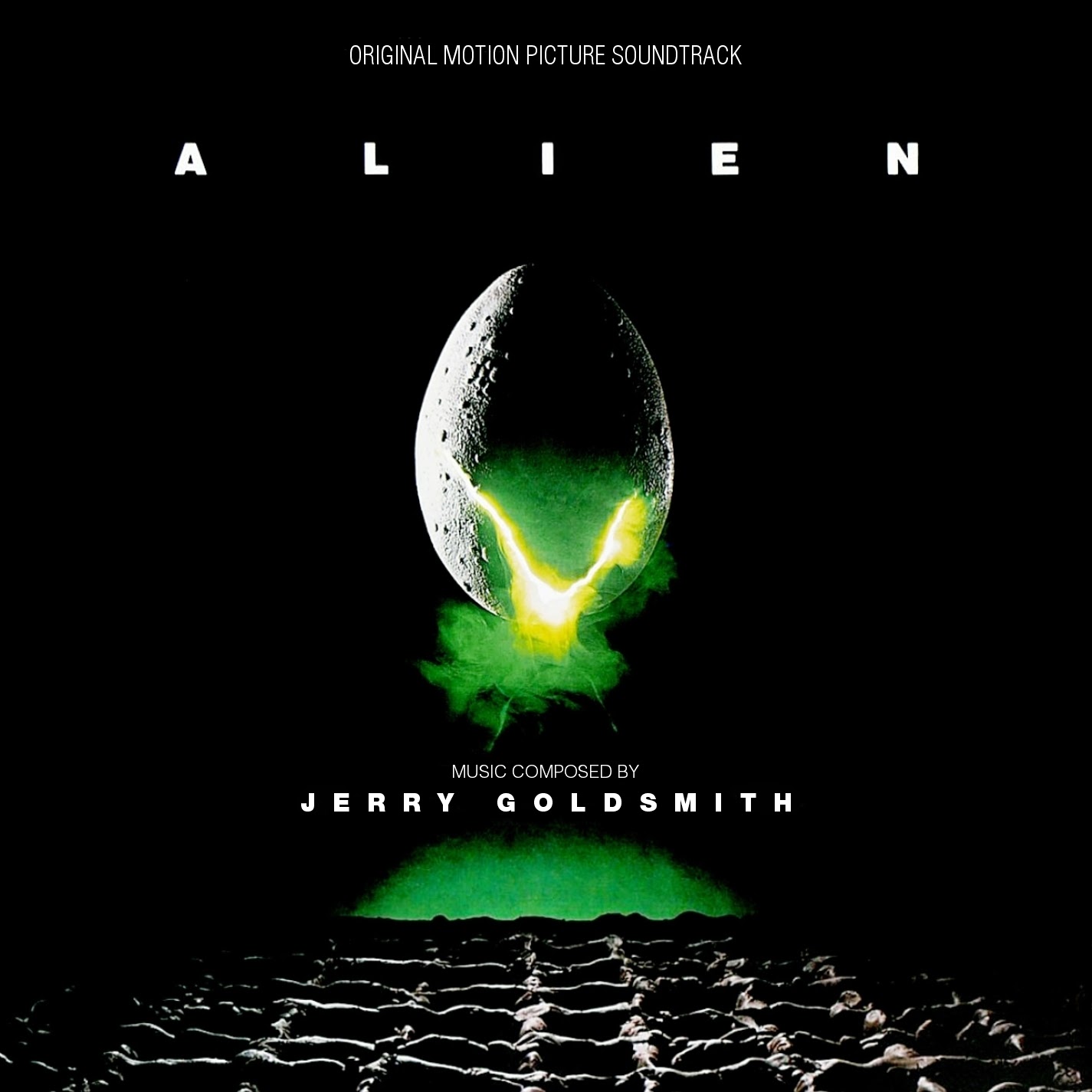
The xenomorph establishes no relation whatsoever with the human. It has no speech, no recognition, no reciprocity. As Mary Douglas explained, the impure is that which violates the categories a culture uses to order the world. The xenomorph belongs exactly to that territory. Its reproductive cycle turns the human body into an incubator and dissolves the boundary between host and parasite, between birth and death. Goldsmith carries that anomaly into the musical plane through a score that avoids stable melody, harmonic resolution, or any clear signal of belonging. The creature is thus left outside every familiar idiom. The music keeps the abyss open and keeps the cosmos from ever being mistaken for a home.
And yet, reducing his music to darkness alone would be as inaccurate as reducing Williams to nothing but a composer of light. In Star Trek: The Motion Picture (1979), Goldsmith also builds wonder, though he gives it a less heroic, more ceremonial character. The wordless choirs, the slow unfolding of the thematic material, and the use of the blaster beam — an instrument of unclassifiable timbre, foreign to both traditional orchestral color and conventional electronics — turn the encounter with V’Ger into an experience that resists the warmth of the classical leitmotif. Rudolf Otto called this kind of experience the numinous: something sacred that both attracts and overwhelms, a mysterium tremendum et fascinans that cannot be reduced to moral or rational categories. Goldsmith’s music turns V’Ger into a presence ritualized as mystery. The entity appears as an intelligence exceeding human capacities, and the sense of awe arises from accepting that smallness rather than overcoming it. Goldsmith preserves distance from the cosmos and elevates it into sacred experience.
The future sounded ancient again with Williams because a technological society needed to recover myth, lineage, and the promise of elevation. Goldsmith remains its necessary counterpoint, the voice that refuses to close the rite and warns that every exploration can lead to wonder, to threat, or to silence. Science-fiction music thus acts as a ritual technology capable of gathering, orienting, and elevating — but also of decentering the human and leaving it suspended in its own margin. Williams made space feel like sky again. Goldsmith reminded us that, beyond that sky, the abyss could also be found.
Readers
Would you like to comment on this essay or suggest a related reading?
Write to us at info@cinetropo.com.