Article
What Is an Alien For? Cinema, Otherness and the Human Mirror
Cinema, Otherness and the Human Mirror.
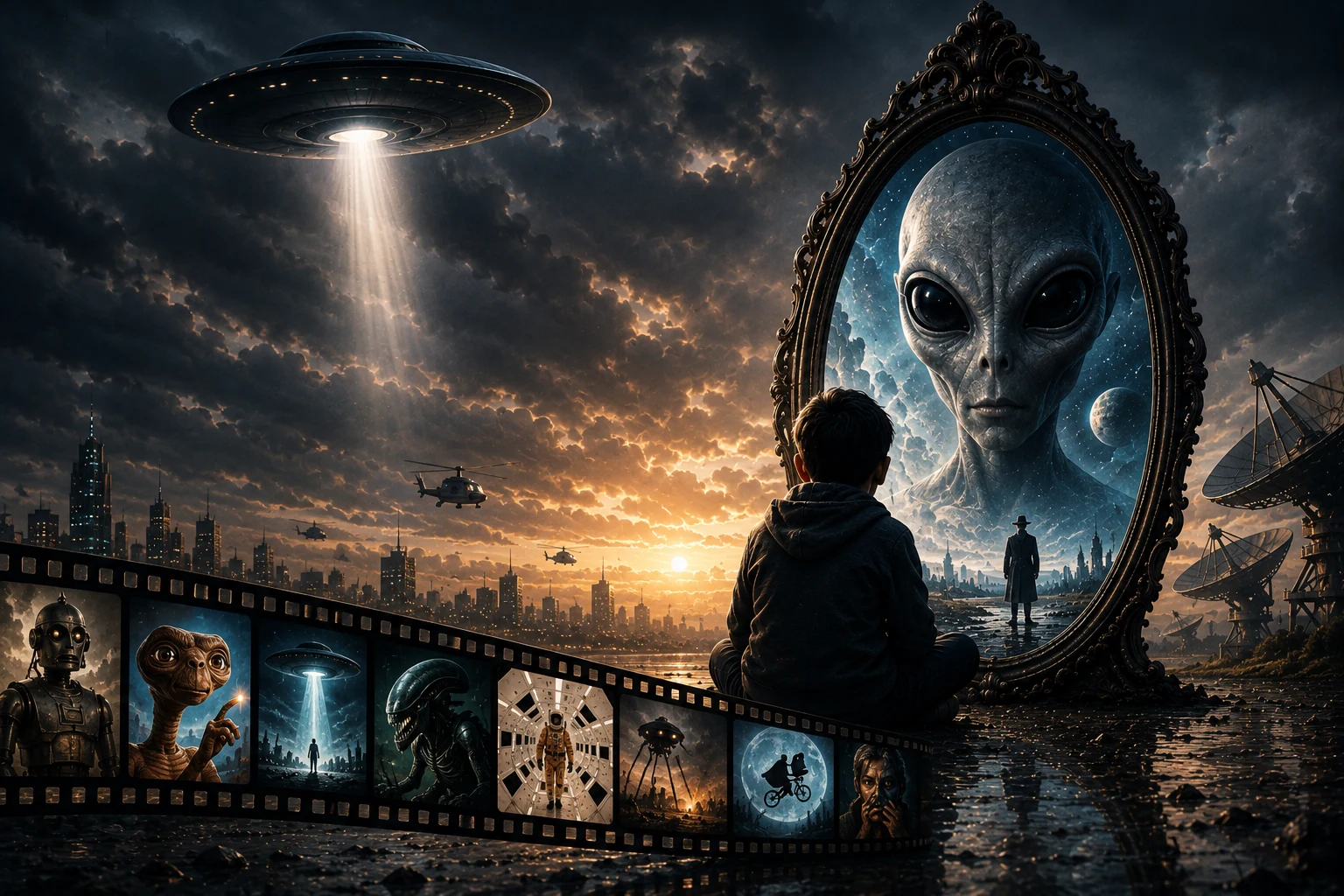
Throughout history, humanity has projected its existential bewilderment onto a series of entities external to ourselves, such as mythical creatures, gods, demons, or beings from the underworld. All of them are symbolic manifestations of the mystery surrounding our own existence. The Other, understood as a philosophical and psychological figure, embodies that which, whether beings, ideas, or identities, is different from or external to the self or to us. This concept unfolds across multiple levels, from the interpersonal to the cultural, and from the social to the metaphysical. It encompasses people, cultures, the unknown, and the unexplored. From the nineteenth century onward, the alien joined this repertoire of figures. As an entity radically removed from human experience, the extraterrestrial came to embody the absolute Other for the contemporary individual.
Narrative, whether literary or cinematic, is an essential means of understanding and structuring reality. Through narrative, we simplify, categorize, and ultimately give meaning to a complex world. Narrative stereotypes reinforce identities and cultural differences, organize social roles into hierarchies, and mediate collective perceptions. Through stories, individuals and societies build the moral framework that allows them to interpret their place in the world and question established beliefs.
Within the cinematic narratives that have entertained us so intensely over the last hundred years, contact with extraterrestrial beings has had a particularly significant role. The key to the allegories offered by cinema lies in the extraordinary capacity of the alien image to operate as a mechanism of estrangement, allowing us to say what would otherwise be unsayable for political, moral, or cultural reasons. When we define the extraterrestrial Other through its inherent non-human condition, the play of opposites enables us to outline and affirm what we understand as human.
The physicist and science fiction writer Gregory Benford once argued that there is no theme more fundamental to science fiction than the alien. The fascination with the foreign, Benford suggests, balances the desire for scientific certainty with the tension of the unknown. The study of the alien is essential because these beings have served as reflections of humanity’s darkest vices, figures that evoke cruelty, fear, and, at times, the lost wisdom of distant civilizations.
Benford’s conclusion can be summarized through an interpretation of Solaris, where genuine contact, the full understanding of the alien, is revealed as impossible. The inherent difficulty in dealing with the truly foreign lies in the fact that humanity is forced to translate strangeness into familiar language, to build bridges between what cannot be reconciled. In that attempt, when we speak of the radically strange, we only project what we are, whether we like it or not.
This risk of turning the alien into metaphor is constant. The foreign inevitably slips into the familiar, into the comprehensible. In science fiction, aliens are not merely beings from other worlds. They are pieces within a limited anthropological economy, instruments used to articulate the human. They become mirrors reflecting our concerns, fears, and aspirations. They play a role within a narrative game whose ultimate purpose is always to see ourselves. Within this economy of strangeness, however incomprehensible the alien may seem, it is always shaped according to its usefulness in understanding our own existence.
When looking at the alien, the human being confronts its own identity, reflected as a stranger in its own land, as a dehumanized being that has lost connection with its essence. We become a riddle to ourselves. Certain currents of thought have suggested that humanity, in its urge to progress, has moved away from nature and sunk into a world of artifices and conventions. Civilization thus becomes a form of barbarism, an alienation that prevents human beings from embracing the generosity of nature and its transformations. This distancing from nature has led humanity to become strange to itself, unable to connect with the essential core of its being.
In science fiction narratives, there are two main kinds of contact story. There is the story in which they contact us, and the story in which we contact them. Both can be deeply reflexive. The aliens who come to us are usually relentless invaders who intend to remove us from the planet and take control of it. They are technologically superior and warn us against the proud assumption that advancement places a civilization above nature.
The aliens we contact, on the other hand, are often friendly. They may be superior to humanity, but they are humble, and the human being feels both flattered and chastened by the encounter. The essential point of those narratives in which we are the aliens lies in the fact that the extraterrestrial world we visit becomes an exemplary model. It illustrates that progress, once again, emerges from balance, and it offers a transcendental lesson about evolution and development, because these creatures do what humanity is always told to do. They know themselves.
It is necessary to ask when human beings understood that the existence of the non-human could serve as a key to understanding themselves. The term alien is not ancient. It is a modern creation, born from a Latin root. Neither the classical world nor the Christian world thought in terms of the alien. They conceived all beings as possessing unity and destiny within the great chain of being, where everything was interconnected and nothing overlapped. In that vision, communication between animals, angels, and humans was possible, because everything was governed by the sacred order of those interconnections. If there were gaps between structures, it was simply accepted that emptiness resided there.
Modernity, however, reinterprets the alien as a presence that inhabits those gaps, a presence distinct from humanity yet linked to it precisely through that difference. Strangeness no longer inhabits the interconnected universe of antiquity. It inhabits empty spaces, which, since they do not belong to us, become a mirror of our own alterity, reflecting the borders of our understanding and existence. In this process, the creation of the Other intersects with the rupture from the natural world, a consequence of Renaissance thinkers removing the human being from natural taxonomies. Having lost the cardinal points that once connected us to the world, humanity is forced to populate those voids with aliens, incomprehensible and monstrous creatures.
Attempts to assimilate what is foreign, what is extraterrestrial, result in another step toward alienation. At the same time, they also offer a unique opportunity for self-knowledge through the questioning of our own beliefs. The encounter with strangeness forces us to leave the closed circle of our human systems and to see the world from a different perspective, one that transforms our vision of life and the future.
The alien acts as a catalyst, a figure that pushes humanity toward change. By leaving a limited perspective behind, we can conceive new forms of existence, new ways of seeing nature, and with them, the possibility of a different future. The alien, then, becomes a key to unlocking new realities, a door toward a humanity more conscious of its place in the cosmos.
With one further turn of the argument, we might consider that the constant search for the alien conceals an attempt to evade the mystery dwelling within us. Sightings and fantasies about encounters with beings from other worlds may be nothing more than a veil, an attempt to avoid what truly matters, confronting our own fears and our deepest contradictions.
Alien cinema can be read as a cartography of fear, desire, and human identity. Its stories change shape, but they almost always return to four major figures.
Four Ways of Looking at the Alien
Alien invasion
The alien as threat.
The War of the Worlds, Invasion of the Body Snatchers, Independence Day, A Quiet Place.
First contact
The alien as question.
2001, Solaris, Close Encounters of the Third Kind, E.T., Arrival.
Cosmic horror
The alien as abyss.
Alien, The Thing, Event Horizon.
Galactic diplomacy
The alien as society.
Star Trek, Star Wars, Enemy Mine, District 9.
These four forms are not sealed compartments. They often contaminate one another, but they help explain why the alien remains one of modern cinema’s most fertile images.
Alien invasion is the canonical and most recognizable model, the trope that unfolds the arrival on Earth of beings from other worlds with belligerent intentions, placing the future of humanity in jeopardy. These plots are characterized by the violent invasion of Earth and contain a symbolic reading that is often obvious, direct, and closely tied to the political context. We are speaking of fears of the unknown, cultural collision, the end of civilization, and the loss of identity.
Visually, this is a genre rich in special effects, with striking designs of spacecraft and extraterrestrial creatures. This narrative approach has captured audiences because it most genuinely symbolizes the fears, tensions, and aspirations of human societies when faced with the unknown and the foreign. The encounter is articulated through conflict, resistance, and survival, in a narrative that combines action, suspense, and sociopolitical reflection.
The deep rooting of alien invasion in collective consciousness owes much to the brief splendor achieved by American cinematic science fiction during the 1950s. Hollywood used these productions to lure audiences back into movie theaters through recurring narratives focused on the devastating effects of radiation, alien invasions, possession of human bodies, and the threat of global destruction. These plots illustrated the possible collapse of the capitalist society represented by the United States.
This category shows remarkable internal coherence and continuity from the beginning of the subgenre, with classics such as The Day the Earth Stood Still (1951) and The War of the Worlds (1953), 1990s hits such as Independence Day (1997), and more recent films such as A Quiet Place (2018).
First-contact cinema, including 2001: A Space Odyssey (1968), Solaris (1972), Close Encounters of the Third Kind (1977), E.T. the Extra-Terrestrial (1982), and Arrival (2016), recreates the initial encounter between humanity and beings from other worlds from a non-conflictual perspective. These narratives begin with concern over a possible threat and with scientific curiosity, but as the plot progresses, they shift attention toward ethical and cultural dilemmas that, from an introspective perspective, question our interpretation of communication, intelligence, and coexistence.
Alien cinema also explored messianic figures in a series of films such as The Man Who Fell to Earth (1976), Superman: The Movie (1978), E.T. the Extra-Terrestrial (1982), and Starman (1984). These narratives sought to soothe the social anxieties that emerged in the early 1970s, in a context marked by the crisis of traditional values, the resulting existential void, and the individual’s sense of insignificance before a modern world perceived as incoherent and devoid of meaning.
Cosmic horror, a genre linked to the work of H. P. Lovecraft, is characterized by ancestral and atavistic terror before the unknown and the ungraspable, where ancient galactic gods, infernal creatures, and parallel realities threaten sanity and existence itself. Alien (1979) and The Thing (1982) are cinematic paradigms in which the insignificance of the human being before the vast universe, extreme abjection, and the fragility of reality are explored. In both films, the human body becomes a symbolic stage where difference and alterity are negotiated and questioned, a battlefield of conflicting forces, especially those representing fundamental dichotomies such as good against evil, order against chaos, or light against darkness.
Lastly, the subgenre of galactic diplomacy is distinguished by its exploration of complex political and social interactions among civilizations in a vast shared universe. Through negotiations, alliances, and interstellar conflicts, this subgenre addresses the challenges of coexistence between alien cultures, while inviting reflection on peace, sovereignty, integration, and racism.
Major science fiction sagas such as Star Trek and Star Wars, along with less widely known films such as Enemy Mine (1985) and District 9 (2009), build scenarios in which, once the surprise of first contact has been overcome, cultural difference becomes the central axis of the narrative. Their purpose is to emphasize both the risks of conflict and the possibilities of understanding and reconciliation between species.
In conclusion, in the contemporary world, the alien becomes the answer to the need to describe what is genuinely outside the human. In attempting to understand its condition and its relationship with the Other, we confront ourselves, since aliens act as beacons drawing us back toward our own identity. Alien stories are the reflection of our humanity before a mirror. And the vision that emerges is usually either that of what we have forgotten how to be or, if we dig into the terrors of the subconscious, the terrifying image of what we have become.
These questions are explored more fully in the book What Are Aliens For?.
Readers
Would you like to comment on this essay or suggest a related reading?
Write to us at info@cinetropo.com.