Article
2001, Solaris and the Cinema of Impossible Contact
Two films suggest that extraterrestrial contact is not chiefly a technical problem but a philosophical one: how do we speak to what resists understanding?
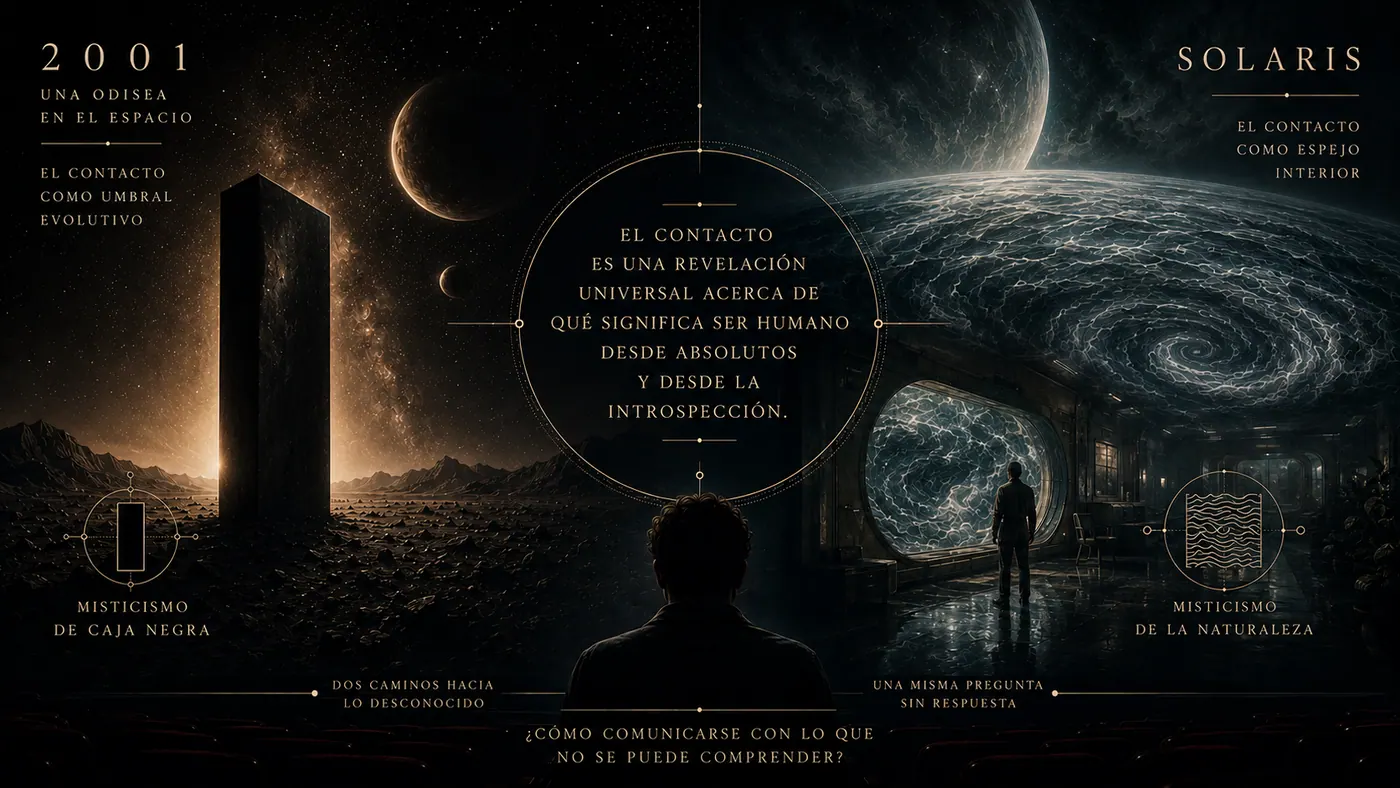
2001: A Space Odyssey and Solaris are often placed on opposite sides of science-fiction cinema: Kubrick’s film technological and geometric, Tarkovsky’s spiritual and wounded. Yet both turn first contact into the same problem. The alien is not a monster to defeat but an intelligence that escapes the categories through which human beings organize the world.
In 2001, the monolith never explains itself. It interrupts history, accelerates evolution and turns knowledge into an encounter with silence. Human language, machines and institutions are left behind by a presence that seems to understand us better than we understand ourselves.
In Solaris, the ocean answers human memory instead of human questions. It does not speak our language; it materializes guilt, desire and grief. Contact becomes unbearable because it forces the crew to face what they carried with them before reaching the planet.
Together, the two films propose a demanding idea of the extraterrestrial: the truly alien is not a body from elsewhere, but the edge of comprehension. Contact fails when we expect the cosmos to behave like a human interlocutor.
Readers
Would you like to comment on this essay or suggest a related reading?
Write to us at info@cinetropo.com.