Article
Anatomy of Cosmic Horror
Alien and The Thing pushed cosmic horror into the body, presenting creatures that unsettle the very notion of identity.
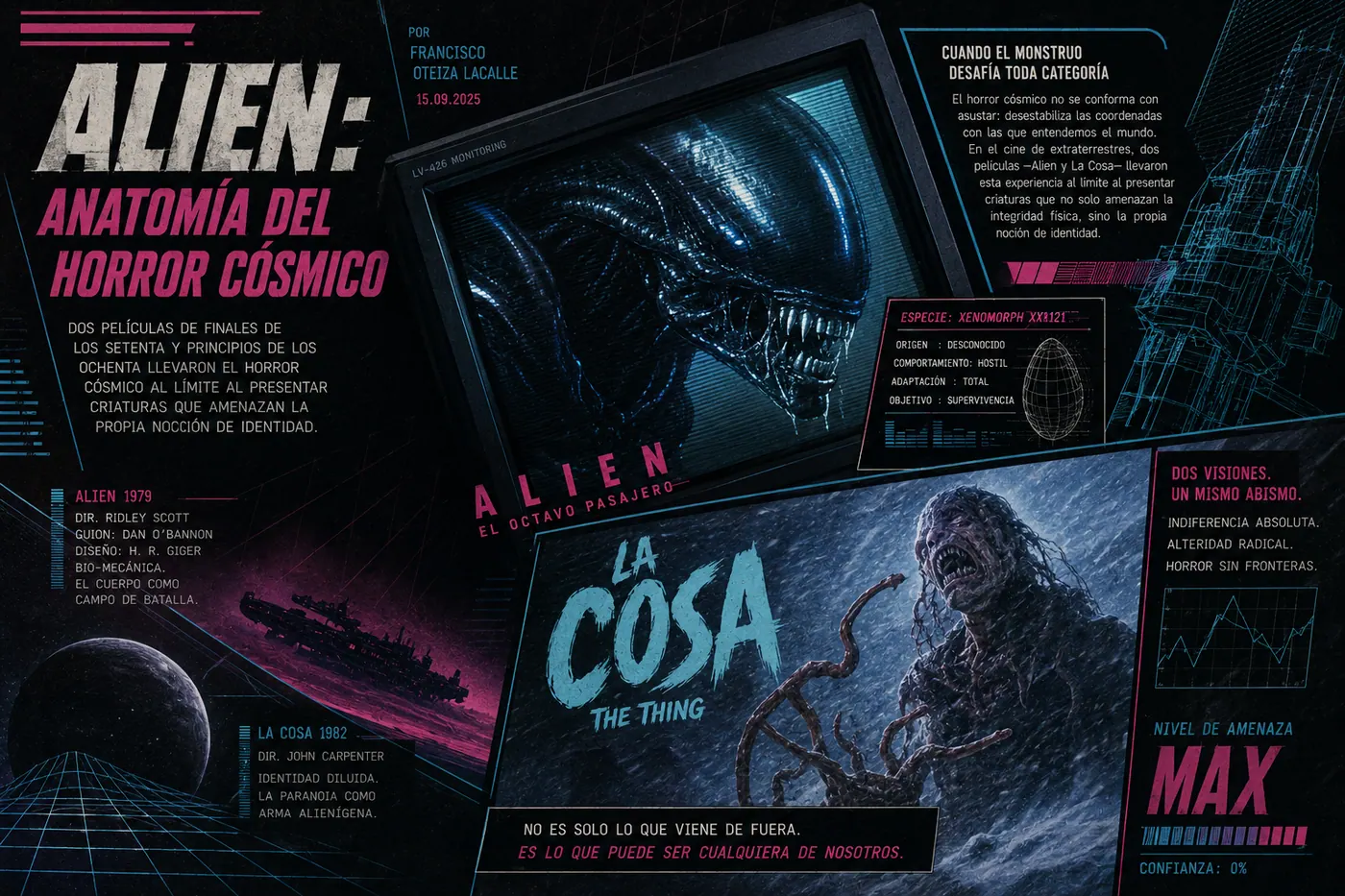
At the turn of the 1980s, Alien and The Thing renewed cosmic horror by moving it out of distant mythology and into intimate biology. Their monsters do not simply arrive from the stars. They enter the body, imitate it, reproduce through it and make identity unstable.
In Alien, the terror is architectural and sexual: corridors, eggs, mouths and wounds form a single hostile organism. In The Thing, the terror is social: any companion may already be something else. Trust collapses because the alien can wear the shape of the familiar.
Both films inherit Lovecraft’s central intuition: the universe is not arranged around human meaning. Cinema gives that intuition flesh. The impossible is seen, but it also bleeds, mutates and screams.
Cosmic horror therefore becomes a crisis of recognition. The question is no longer what the monster wants, but whether the human form is still a reliable sign of humanity.
Readers
Would you like to comment on this essay or suggest a related reading?
Write to us at info@cinetropo.com.