Article
The Other Has Always Been Here
Long before cinema imagined alien life, our species lived alongside beings not entirely like us: Neanderthals, Denisovans and other hominins.
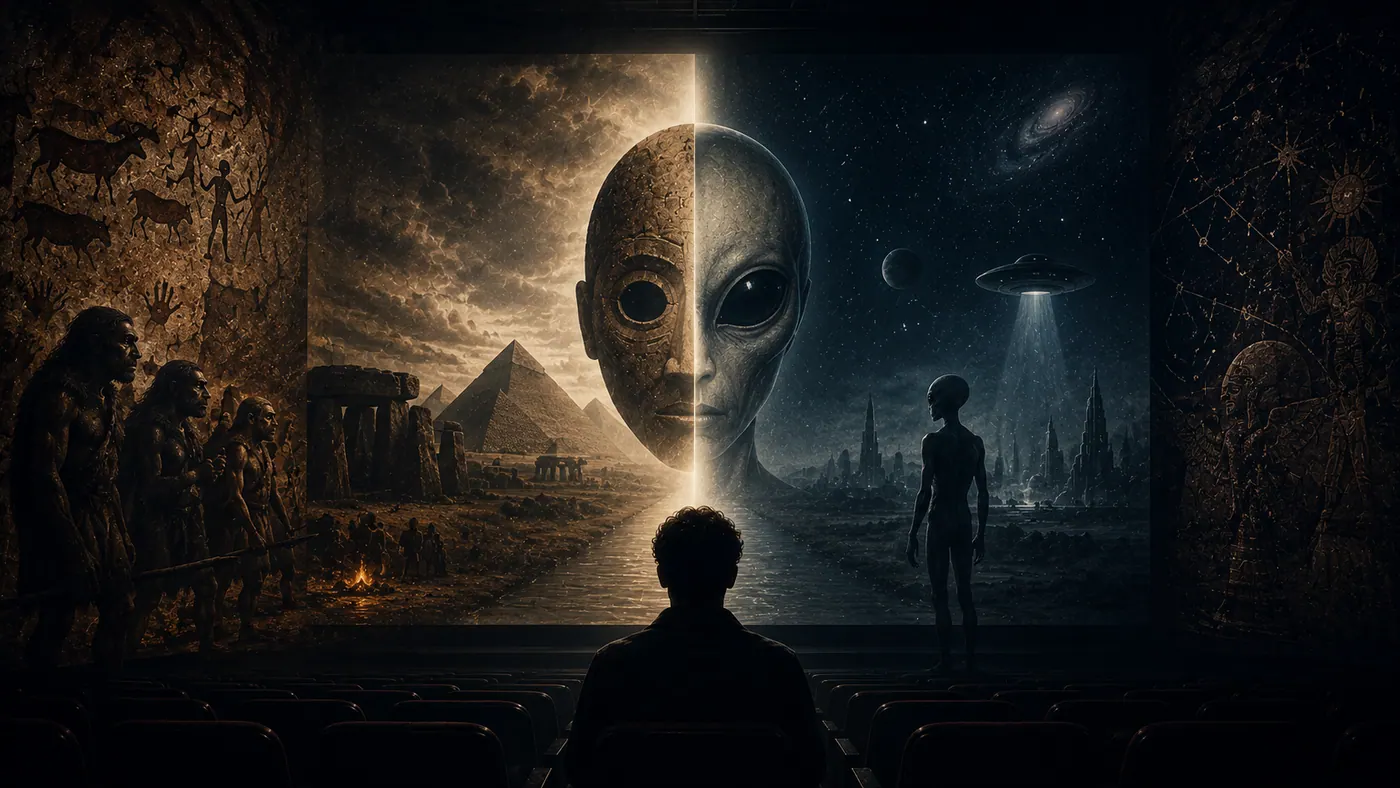
The alien may look like a modern figure, born of rockets, telescopes and flying saucers, but the experience of otherness is much older. Humanity has always defined itself in relation to neighbours, enemies, spirits, animals and extinct relatives.
Before cinema imagined visitors from space, Homo sapiens had already shared the planet with other human forms. Neanderthals and Denisovans remind us that the boundary of the human was never as simple as our myths would like.
Science fiction inherits that deep anthropological problem. The alien is a way of staging the question of who belongs inside the circle of the human and who remains outside it.
That is why extraterrestrials are never only extraterrestrial. They reactivate older stories about tribes, gods, demons and strangers. The other has always been here; cinema merely gave it a new body and a new sky.
Readers
Would you like to comment on this essay or suggest a related reading?
Write to us at info@cinetropo.com.